



Photostory by Charles Dickson
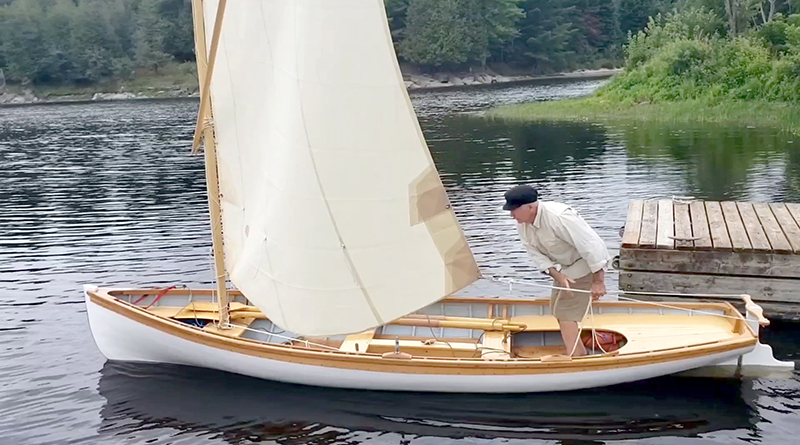
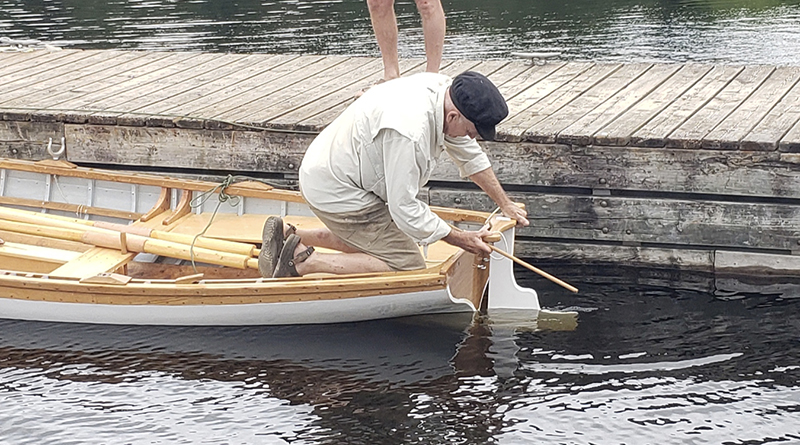
It was a mid-summer’s Saturday morning when Tim Jones stepped off the Portage wharf onto his home-made sailboat.
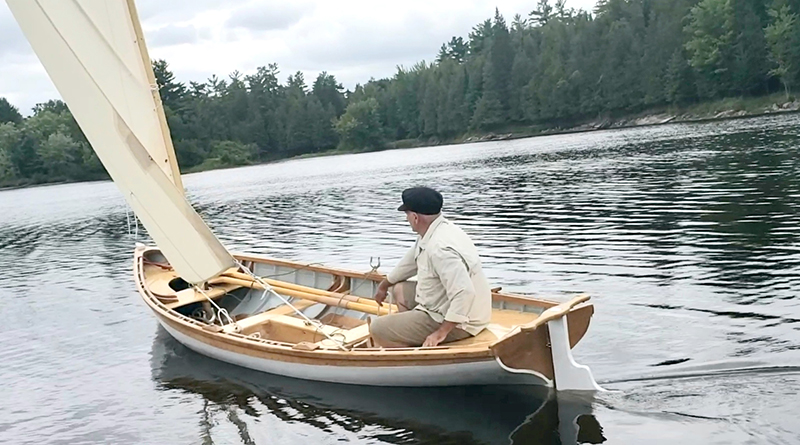
As he pulled up the sail and caught a gentle breeze, the craft moved silently out into the calm waters of the Ottawa River that flow past Portage-du-Fort in the shelter of Limerick Island.
A few friends, neighbours and fellow boat-building enthusiasts gathered by the ramp to witness the launch.
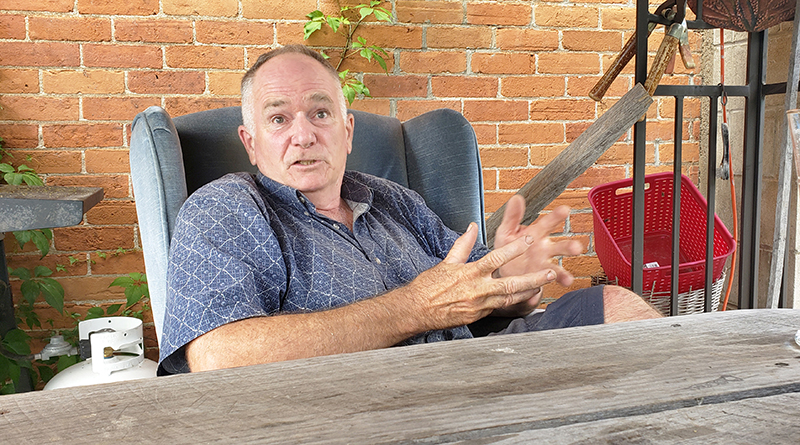
“Believe me, it is extremely satisfying,” he said later over a beer.
Whether he was referring to the peaceful pleasures of sailing or the joy of creating something so beautiful with his own hands is not clear, but there was a hint in his voice of a meaning that ran a bit deeper.
Not long ago, Tim lived and worked in Ottawa as a land developer employed by various companies. But his passion has long been building and selling sailboats, which he has been doing for more than 30 years as a kind of a side gig, as he put it, initially in the basement of his former Ottawa home.
Instead of screws or rivets to hold his boats together, he would tap the wood and use machine bolts so he could dismantle his boats and move sections out through the basement window for reassembly outside. The procedure sounded like the reverse of putting a ship in a bottle. “Ya, it’s like taking it out of a bottle,” he laughed.
“But working in an office, I realized, was going to kill me, and render me utterly useless,” he said. “I had ambitions of things I wanted to do.”
“So, I kind of dropped out in 2013. I knew I had to do it. I could not hack sitting in an office. I could feel my body deteriorating and I could feel my initiative slipping away.”
“Kids were paid off, healthy and were taking care of themselves. So, I dumped everything I owned and I bought an old boat and went sailing. Spent two years living on a boat,” he said.
The boat he bought was a 34-foot Tartan, a modern sloop, built in 1972.
“They were brilliantly built, strong boats from an era that you could get for nothing, basically, if you knew what you were doing,” said Tim.
From their point of departure in Hudson, Quebec, Tim and his girlfriend sailed to Montreal, down the St. Lawrence and all the way around Newfoundland, clockwise, as he clarifies. From there they sailed south, down the eastern seaboard to the Bahamas where his girlfriend jumped off at St. George. Tim pressed on to Cuba where he spent the winter before sailing back up for a summer cruising Lake Ontario. Then it was a winter of skiing in Revelstoke while visiting his son who was studying in Victoria at the time.
But after being on the move for a couple of years, Tim decided it was time to find a place to live, ideally somewhere not too far from family. By then, his kids were in Ottawa and Montreal and his father was living in south-western Ontario.
Tim’s father had fought in both World War II and the Korean War, and was stationed at CFB Petawawa with his family in the early 1970s. Despite spending a few years in the upper Ottawa Valley as an army brat, as he describes himself, Tim has no recollection of ever having heard of, much less seen, Portage-du-Fort.
“But when I saw this place, it was like ‘Wow, I’m in!’” he said. “It’s got everything I want. I can ski out the back door here, there’s thousands of acres of forest, and two boat launches – one on each side of the dam. I also like canoeing and outdoor stuff, so it’s perfect.”
For Tim to say that he ‘likes canoeing and outdoor stuff’ is a bit of an understatement. To hear his stories, it is clear he is a bit of an adventurer. He talks of paddling on some of the great reservoirs in Quebec, for example, such as Lac Poisson Blanc, which he describes as big and beautiful but also quite dangerous “because the wind would come up out of the north, and there’d be three-foot breaking waves.”
According to his friend Barry Stemshorn, Tim is also a superb skier.
“I’ve done several off-piste tours with him in woodlands of the Nature Conservancy of Canada, in Clarendon and Litchfield. I’m a pretty good back country tourer and telemark skier and have skied with many experts, but Tim is in a class of his own, able to handle un-groomed snow, steep slopes and narrow spaces between trees,” says Barry.
“He’s been referred to as the ‘mystery skier’ for leaving tracks in places not often travelled in winter.”
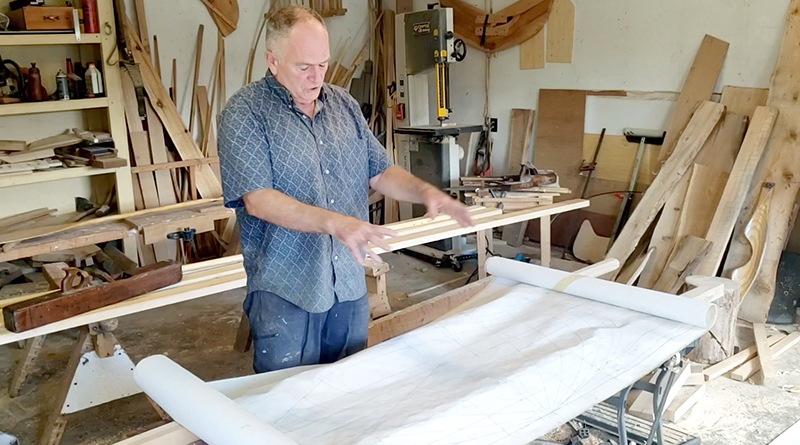
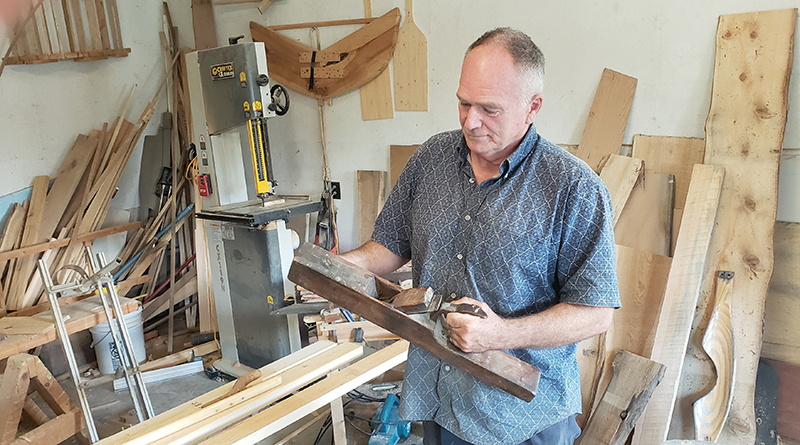
When Tim arrived in Portage, all he had was a station wagon full of woodworking tools. But it was all he needed to set up a workshop in the building next to his new home and resume building boats.
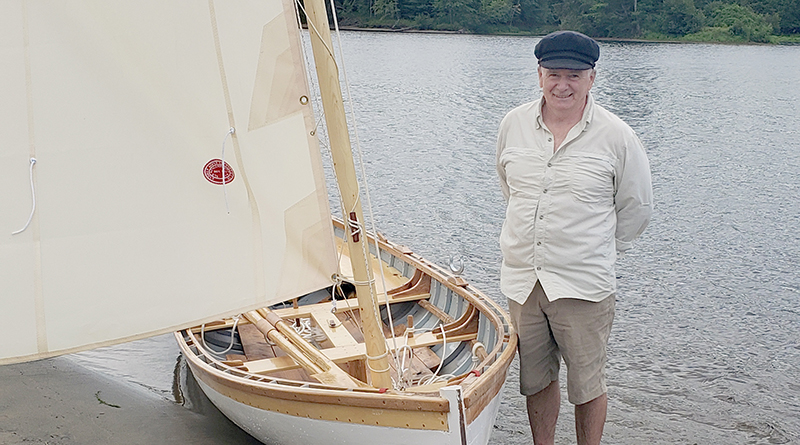
Tim has a particular fondness for the Whitehall design, the kind of boat he launched in Portage this summer. He says the Whitehall is believed to have originated in New York. It takes its name from Whitehall Street near the tip of Manhattan, at the foot of which was a dock where these boats were once used as harbour taxis, ferrying sailors and chandlers to and from ships parked out in New York Harbour.
The boats range in length from 14 to 18 feet. They have a very pointy bow, a wineglass-shaped transom (stern), and a centreboard. The rigging is simple, with a free-standing mast and a sprit (diagonal spar) from which the sail is suspended, all of which can quickly be taken down and stowed out of the way when rowing is required. The hull is framed every nine inches and covered with half-inch cedar planks. While very solid, it weighs just a little more than 200 pounds.
The previous Whitehall that Tim built was sold to Netflix for use in the production of a yet-to-be-released film called Slumberland.
“I sold another one to a systems engineer from NASA. He told me there’s a NASA boardroom with a picture of my boat in it,” he says with a smile.
“One day, this systems engineer called me from Delaware to say he had forgotten how to rig the boat. This guy, he designs rockets, right? So, it turns out it is rocket science after all!” he says jokingly.
Of the five years he has now lived in Portage, Tim has spent much of the past two in Strathroy, Ontario, caring for his elderly father, determined to help him live out his days at home. It was the time of covid. The distances were great.
“That was fairly stressful,” he said, “but I am proud to say he had a fairly good last couple of years.” His father passed away in April at the age of 96.
“He was healthy right up to the last three weeks. I’m glad about that, anyway.”
As for the future, Tim plans to keep building and selling sailboats.
“I have an idea for a boat more for the local market,” he says, “a traditional sailing and rowing boat that would be great for fishing or whatever you want.”
“Plus, I want to make my own expedition boat, something a bit bigger than the Whitehall and more weatherly, for rougher conditions.”
He talks of sailing such a vessel through the north channel of Lake Huron and maybe on to Lake Superior, a body of water that, to lesser mortals, seems more like an ocean than a lake.
“I want a boat that’s maybe a bit more powerful sailing but that I can still row if I have to, and that you can pull up on a shore if you are more hard-pressed,” says Tim in his understated way of describing the occasional need to seek refuge from life-imperiling seas.
But on this morning by the Portage wharf, it is a gentle breeze that catches the sail, and calm water through which the hull gracefully glides, a peaceful moment along a life’s journey, deeply satisfying for anyone able to savour it.